
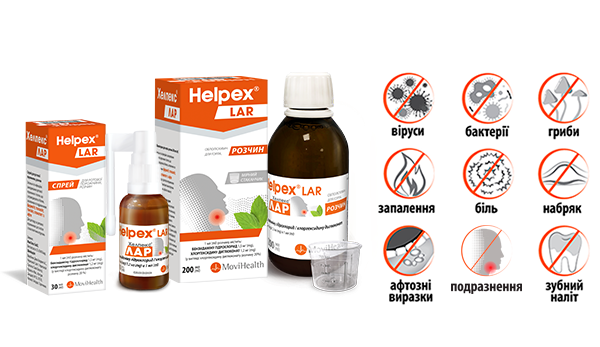
Helpex® LAR Solution and Spray
chlorhexidine digluconate 0,12%
benzydamine hydrochloride 0,15%
Throat rinse, solution 200 ml
Oral spray, solution 30 ml
- The only one in Ukraine1 enhanced2 with an antiseptic - chlorhexidine and a local anti-inflammatory spray with an analgesic effect for sore throat
- Active against the most important pathogenic types of microorganisms: viruses, bacteria, yeast, fungi3
- No dyes, no gluten, no lactose, no sugar
- Solution for tonsillitis and stomatitis5
- Spray for pharyngitis and sore throat4
Helpex LAR® Spray Application Method
Adults and children over 12 years of age: 4 sprays every 1.5–3 hours, up to 5 times per day.
The dose is applied directly to an inflamed area.
Before the first use, a bottle sprayer should be directed away from a face and pump should be pressed several times in order to obtain a fine spray.
A bottle should be stored in a box, in vertical position.
Helpex® LAR solution Application Method
Used for adults and children over 12 years of age mouth rinsing. Measure 15 ml of solution into a measuring cup, apply undiluted or diluted (with the same amount of water), rinse 2–3 times a day with an interval of 3–5 hours. If necessary, the number of rinses can be increased to 4 times a day. Keep in the mouth for at least 30 seconds, do not swallow.
Do not use for more than 7 consecutive days without consulting a doctor. The drug reduces plaque and gingivitis during treatment.
When used as an alternative to oral hygiene procedures, a solution should be kept in mouth for at least 1 minute.
Children.
A medicine is used for children from 12 years of age.
Pharmacotherapeutic group.
Means for use in stomatology. Other means for local use in the oral cavity. Code АТХ А01А D02.
Pharmacological properties.
Helpex® LAR — antiseptic, analgesic, anti-inflammatory agent used for inflammatory and infectious diseases of the oral cavity and throat, accompanied by pain, inflammation and irritation: pharyngitis, tonsillitis, gingivitis, stomatitis and aphthae.
Benzydamine is non-steroidal anti-inflammatory drug (NSAID); has an anti-inflammatory, analgesic and anti-exudative effect, with local application it has an anesthetic effect on the mucous membrane of the oral cavity.
Clinical effectiveness of benzydamine was demonstrated in clinical studies conducted for benzydamine in patients with localized inflammatory processes in oral cavity and pharynx accompanied by pain. An analgesic effect of benzydamine has been reported more frequently in models of experimental inflammation than in non-inflammatory pain. Its effectiveness when used locally is caused by an ability to penetrate epithelial layer and reach effective concentrations in inflamed tissues.
Benzydamine inhibits cyclooxygenase and lipoxygenase and suppresses the synthesis of prostaglandins.
Further mechanisms of action are associated with the inhibition of the oxidative burst of neutrophils, as well as membrane stabilization by inhibiting the release of granules from neutrophils and stabilization of lysosomes. Local anesthetic activity is associated with interaction with cation channels.
Chlorhexidine is a cationic biguanide antiseptic; has an antibacterial, bactericidal and prolonged bacteriostatic effect when applied topically on a wide range of gram-positive and gram-negative bacteria, yeast, dermatophyte fungi, lipophilic viruses (influenza, herpes, HIV, etc.) and is thus active against most important pathogenic types of microorganisms of the microflora of oral cavity.
It binds to mucous membrane and inhibits growth of bacteria due to delayed surface action. Chlorhexidine is a strong base with an affinity for oral structures including hydroxyapatite of tooth enamel, tooth surface layer, bacterial protein and salivary protein.
It is absorbed by the phosphate-containing areas of the microbial cell wall, which disrupts the integrity of the cell membrane.
It is effective for a wide range of pathological conditions from oropharynx side. Reduces a formation of plaque and associated gingivitis, which manifests as red, swollen or bleeding gums. Reduces frequency of aphthous ulcers and increases a speed of healing after surgery. Reduces a development of tartar and gingivitis when normal oral hygiene measures are not possible.
See full details in an instruction for medicinal product medical use.
Indication:
- Inflammatory and infectious diseases of an oral cavity and pharynx accompanied by pain, inflammation and irritation: pharyngitis, tonsillitis, gingivitis, stomatitis and aphthae.
- For oral care before and after dental interventions.
Contraindication:
Hypersensitivity to benzydamine, chlorhexidine or any other component of the medicinal product.
For external (oral cavity only) use; avoid contact with eyes and ears, in case of contact with eyes, immediately rinse thoroughly with plenty of water.
A medicine does not need to be diluted, it should not be swallowed, it should be coughed up after each use.
In case of sensitivity during the use of the drug, the treatment should be stopped and a doctor should be consulted.
If the patient's condition does not improve after 3-4 days from the start of treatment, a doctor should be consulted to determine further treatment.
Benzydamine should not be used in patients with hypersensitivity to acetylsalicylic acid or other NSAIDs.
The use of drug can cause bronchospasm in patients with bronchial asthma or who have a history of bronchial asthma. Such patients must be warned about this.
A medicine can cause change in color of teeth and tongue. Before using medicine, you should brush your teeth to minimize their discoloration.
The drug contains a small amount (less than 100 mg) of ethanol (alcohol) in each dose.
For athletes: a use of medicinal products containing ethyl alcohol may give a positive result in a doping test, given limits set by some sports federations.
Do not use during pregnancy or breastfeeding due to the lack of adequate data on safety of use.
See other features of application in the instructions for medical use of the medicinal product.
Store in original packaging, at a maximum temperature of 25°C.
Keep out of the reach of children.
R.С. MOH of Ukraine UA/18887/01/01 date 06.08.2021